+1 315 210 4488
 +91 99888 06489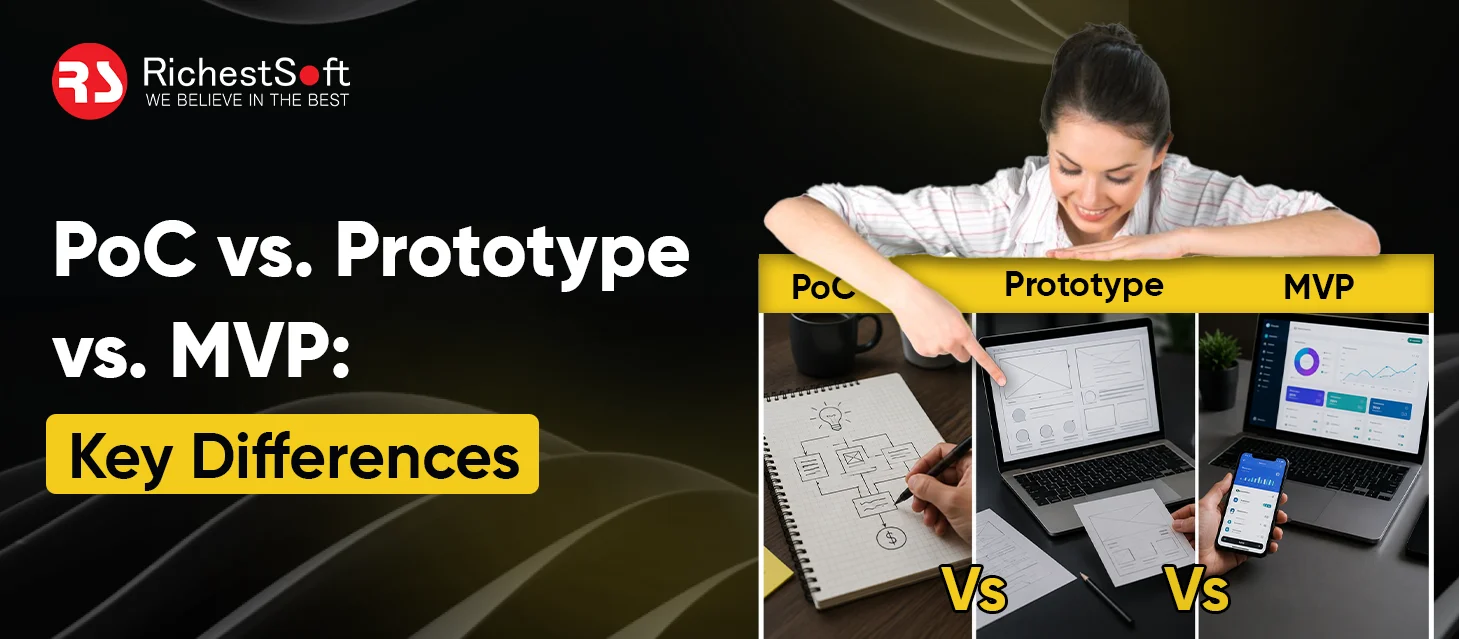


June 17, 2026
If you’re planning to build a new product, one of the first questions you’ll face is whether to start with a Proof of Concept (PoC), a Prototype, or a Minimum Viable Product (MVP).
While these terms are often used interchangeably, they serve very different purposes in the product development process. A PoC helps validate whether an idea is technically possible, a Prototype shows how the product will look and function, and an MVP allows real users to test a working version of the product.
Understanding the differences among these three approaches can help startups reduce risk, validate ideas faster, and invest development resources more effectively. That’s exactly why we have created this post.
Get Expert Guidance on PoC, Prototype, and MVP Development with RichestSoft
Get Expert Guidance on PoC, Prototype, and MVP Development with RichestSoft
What Is a Proof of Concept (PoC)?
A Proof of Concept (PoC) is an early-stage project created to determine whether an idea, technology, or feature is technically feasible.
The primary goal of a PoC is not to build a product but to answer a simple question: Can this idea actually work?
Businesses typically create a PoC before investing significant time and money into development, especially when working with innovative technologies such as AI, blockchain, AR/VR, IoT, or complex software integrations.
Benefits of PoC
- Verifies technological viability
- Finds development issues
- Reduces project risk
- Development cost savings
- Ensuring shareholder or investor trust
Example
A start-up is trying to develop an AI-driven healthcare app. The team builds a PoC to evaluate whether the AI model can assess medical data properly before building the final product.
What Is a Prototype?
A Prototype is a visual depiction of a product that depicts the design, user interface, and user experience.
Prototypes are used to display the look and feel of the product and how the user will interact with it, unlike PoCs. It may have clickable screens, navigation flows, and interface designs, but generally doesn’t offer full functionality.
The purpose of Prototype is to check the user experience before starting development.
Advantages of a Prototype
- Visualize product concept
- Enhances UI/UX planning
- Collects stakeholder input
- Detects usability problems early
- Minimizes requests for design changes
Example
A food delivery startup creates clickable app screens showing registration, restaurant listings, ordering, and checkout processes before writing any development code.
What Is a Minimum Viable Product (MVP)?
Minimum Viable solution (MVP) is a working solution with just the key elements required to address a user’s issue.
An MVP is released to actual consumers, unlike a PoC or Prototype. The purpose is to collect input, assess the market, and build a better product based on real consumer behavior.
An MVP helps entrepreneurs reach the market more rapidly and lower development expenses.
Advantages of an MVP
- Validates market demand
- Capturing the genuine user input
- Generates early revenues
- Draws investors
- Accelerates time to market
Example
Businesses investing to develop a Uber-like app with the basics – Rider Registration, Driver Registration, Booking a Ride, Payments, Ride Tracking, etc. The sophisticated features may come later.
PoC vs. Prototype vs. MVP: A Comparison Table
Although all three approaches help validate an idea, they answer different business questions.
| Factor | PoC | Prototype | MVP |
|---|---|---|---|
| Main Goal | Validate feasibility | Validate design and user experience | Validate market demand |
| Development Stage | Earliest stage | Planning and design stage | Pre-launch stage |
| Target Audience | Internal teams | Stakeholders and testers | Real users |
| Functionality | Limited or none | Partial simulation | Working product |
| User Testing | No | Limited | Extensive |
| Time Required | Low | Medium | High |
| Cost | Lowest | Moderate | Highest |
| Outcome | Feasibility validation | Design validation | Market validation |
In simple terms:
- A PoC proves the idea can work.
- A Prototype shows how the product will work.
- An MVP tests whether customers actually want it.
PoC vs. Prototype vs. MVP: How to Pick the Best Approach for Your Startup?
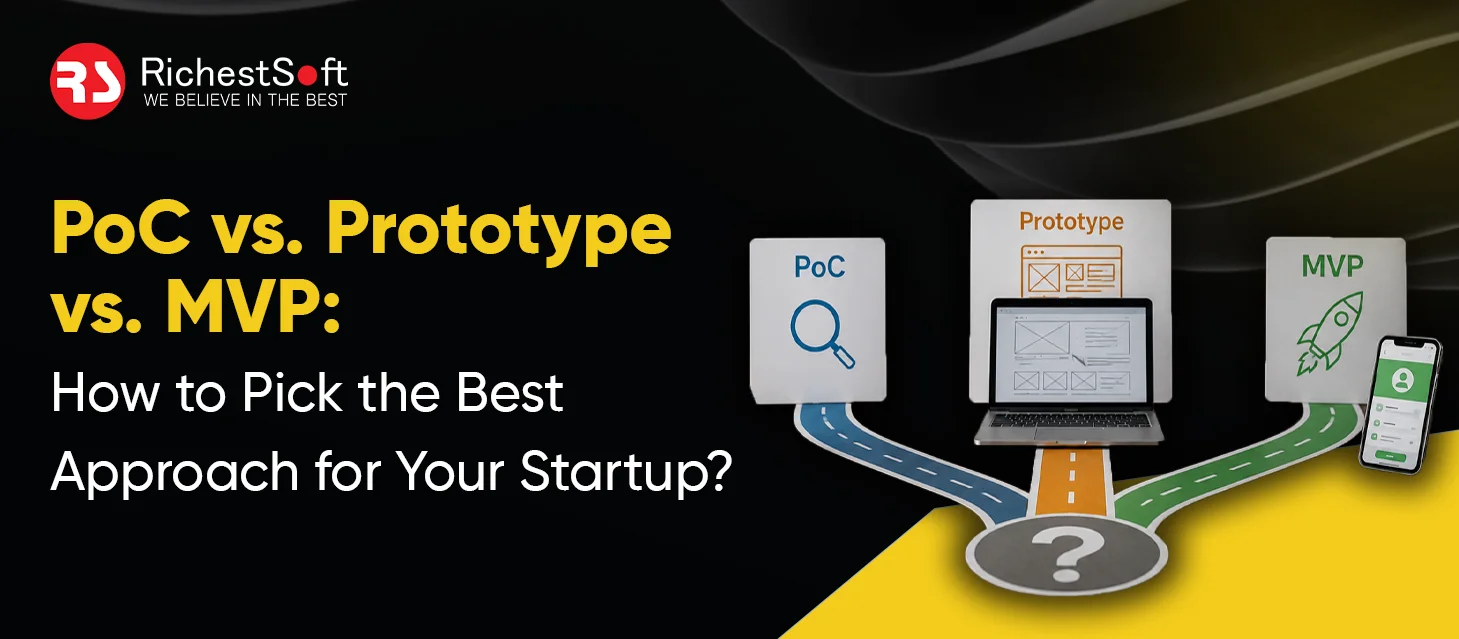 Here are easy tips to determine which approach is best:
Choose a PoC to Validate Technical Feasibility
If your proposal is based on new and/or sophisticated or unproven technology, the initial step should be a Proof of Concept.
When a PoC is the correct decision
- Creating an AI-enabled solution
- Building a blockchain application
- AR/VR platform development
- Testing complicated integrations
- Exploring a new technological idea
A PoC helps decrease technological risks early in the process before making large investments into product development.
Choose a Prototype to Validate the User Experience
When the technology is known, but you don’t know how people will use the product, a Prototype is typically the best choice.
When a Prototype is Correct:
- Testing app design and navigation
- User journey optimization
- Gathering stakeholder input
- Pitching to investors
- Improve the UI/UX before development.
This validates the design early on and helps the companies avoid expensive adjustments while in development.
Choose an MVP to Validate Market Demand
If you’re comfortable with the technology and user experience, then invest in an MVP.
You should build an MVP when:
- Launching a new product
- Testing demand on the customers
- Getting the early adopters
- Validation of Pricing Strategies
- Collecting real-world feedback
An MVP is a great way for companies to accelerate their launch process, get vital customer input, and enhance the product according to real market need, not assumptions.
Consider your budget and timeline.
Another critical issue is the time and money you have available.
- A PoC is often the quickest and cheapest choice.
- A Prototype demands more effort in design and less in development.
- The MVP costs the most since it is a working product that is distributed to actual consumers.
Startups with limited resources can initially test the highest risk and avoid wasteful expenditure later.
The Best Approach for Most Startups
In many circumstances, companies don’t need to select just one. No, they have a gradual process of validation:
PoC -> Prototype -> MVP -> Mature Product Development
Initiate by confirming the technology. Then try out the user experience. •Finally, test market demand before developing a whole product.
Note: Not every business requires all three phases. For example, if your project is a traditional marketplace, SaaS platform, or delivery software with the use of known technology, you may skip the PoC and go straight to a Prototype or MVP. However, businesses dealing with AI, blockchain, and other new technologies typically benefit from beginning with a PoC.
Get Expert Guidance on PoC, Prototype, and MVP Development with RichestSoft
Get Expert Guidance on PoC, Prototype, and MVP Development with RichestSoft
Conclusion
Wondering whether your company requires a PoC, Prototype, or MVP? That’s when RichestSoft can assist!
We allow aspiring entrepreneurs to convert startup idea into successful digital products, whether through PoC, interactive prototype, MVP, or full-scale software solutions.
Our team can help you identify the correct approach and build a solution that meets your company’s objectives, whether you’re validating a new idea or preparing for market launch. Contact us now!