+1 315 210 4488
 +91 99888 06489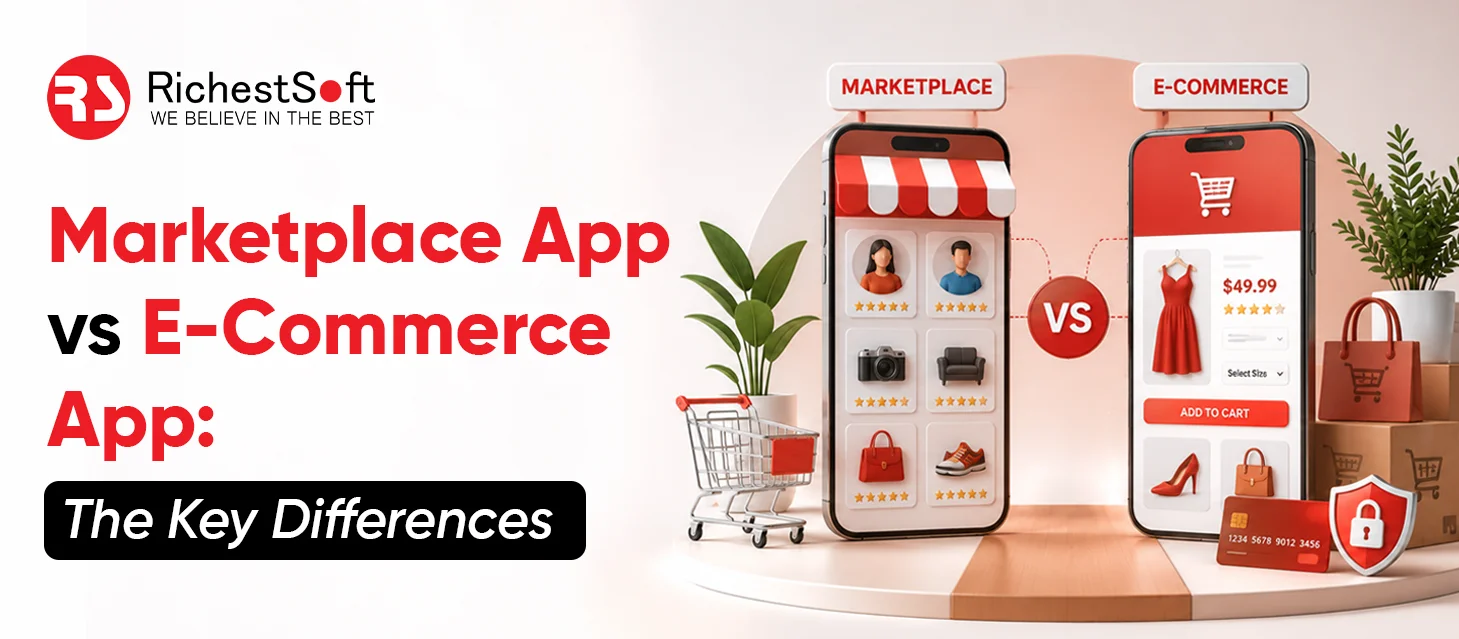


August 21, 2026
Choosing between a marketplace app vs an e-commerce app depends on your business model, target customers, product ownership, and growth plans. A marketplace app allows multiple sellers to offer products on a single platform, while an e-commerce app typically lets a single business sell directly to customers. If you are starting a business, understanding the difference is essential
Below, explore an in-depth comparison between a marketplace app and an e-commerce app.
Build a Scalable Shopping App with RichestSoft.
Build a Scalable Shopping App with RichestSoft.
What Is a Marketplace App?
A marketplace app lets vendors sell items together. It matches merchants with clients while the platform owner oversees items, orders, payments, and sellers. Commissions, seller fees, and subscriptions fund the site.
How Does a Marketplace App Work?
A marketplace mainly has three types of users:
Customers
- Browse products
- Compare Options
- Place Orders
- Make Payments
Sellers
- Create profiles
- Add Products
- Set Prices
- Manage Orders
Admin
Manages-
- Sellers
- Customers
- Products
- Payments
- Commissions
- Platform
Key Features of a Marketplace App
Seller Registration
Sellers can create accounts and provide their business details.
Main options:
- Seller sign-up
- Business details
- Profile verification
- Admin approval
Seller Dashboard
Sellers can manage their store and sales from one dashboard.
Sellers can:
- Add and edit products
- Update prices
- Manage orders
- Check sales
Product Listings
Sellers can add important product information.
Listings can include:
- Product photos
- Description
- Price
- Category
- Stock details
Search and Filters
Customers can quickly find products using different filters.
Customers can filter by:
- Price
- Category
- Location
- Rating
- Seller
Cart and Payments
Customers can add products to their cart and complete their purchase.
Payment options may include:
- Credit/debit cards
- UPI
- Digital wallets
- Online banking
Order Management
Sellers and admins can manage orders from purchase to delivery.
They can track:
- Order status
- Shipping
- Cancellations
- Returns
Reviews and Ratings
Customers can share their experience after buying a product.
This helps to:
- Build customer trust
- Help buyers compare products
- Improve seller quality
Commission Management
The platform can manage the commission charged on each seller’s sale.
It can track:
- Commission rates
- Seller earnings
- Platform fees
- Payment records
Admin Dashboard
The admin gains control of the entire marketplace.
Admins can manage:
- Sellers
- Customers
- Products
- Orders
- Payments
- Commissions
What Is an E-Commerce App?
E-commerce apps provide companies with a platform to sell items directly to consumers. Usually, it’s not like a marketplace where one founder/operator-seller deals with items, price, inventory, and orders.
How Does an E-Commerce App Work?
The business manages the complete shopping process.
The business can:
- Add products
- Set prices
- Manage inventory
- Process orders
- Accept payments
- Handle deliveries and returns
Key Features of an E-Commerce App
Product Catalog
The business can display its products with all the information customers need.
A product page can include:
- Product photos
- Description
- Price
- Category
- Availability
Product Search
Customers can search for products without browsing the entire catalog.
Search can include:
- Product name
- Keyword
- Category
- Brand
Shopping Cart
Customers can review their selected products before placing an order.
The cart allows users to:
- Add products
- Remove products
- Change quantities
- Check the total price
Wishlist
Customers can save products they may want to buy later.
Users can:
- Save products
- Remove saved products
- Move products to the cart
Checkout and Payment
Customers can enter delivery details and select their preferred payment method.
Payment options may include:
- Cards
- UPI
- Digital wallets
- Online banking
Order Tracking
Customers can check the status of their orders.
They can see:
- Order confirmation
- Processing status
- Shipping updates
- Delivery status
Customer Accounts
Customers can manage their personal shopping information.
Accounts can include:
- Personal details
- Saved addresses
- Order history
- Wishlist
Discounts and Coupons
Businesses can offer deals to attract customers and increase sales.
Common offers include:
- Discount codes
- First-order offers
- Seasonal deals
- Special promotions
Inventory Management
The business can track its available stock.
It helps to:
- Monitor stock levels
- Update product availability
- Avoid overselling
- Manage products efficiently
Admin Panel
The admin can manage the entire e-commerce app from a single place. They handle:
- Products
- Customers
- Orders
- Payments
- Inventory
- Discounts
- Sales reports
Marketplace App vs E-Commerce App: Key Differences
Below are the key differences to help you understand which model fits your business.
| Factor | Marketplace App | E-Commerce App |
|---|---|---|
| Sellers | Multiple sellers can sell on the platform. | Usually one business sells its products. |
| Product Ownership | Products belong to different sellers. | Products are owned or managed by one business. |
| Inventory | Each seller manages their own stock. | The business manages all inventory. |
| Revenue Model | Can earn through commissions, seller fees, and subscriptions. | Mainly earns through product sales and other offers. |
| Seller Management | Requires seller registration, verification, and management. | Usually does not need seller management. |
| Product Variety | Can offer products from many sellers and brands. | Product range depends on the business. |
| Development Complexity | More complex because of seller-side features. | Usually simpler to manage. |
| Admin Management | Admin manages sellers, customers, products, orders, and commissions. | Admin mainly manages customers, products, orders, and inventory. |
| Customer Experience | Customers can compare products from different sellers. | Customers shop directly from one brand. |
| Scalability | Can grow by adding more sellers and products. | Can grow by adding products, customers, and sales channels. |
Marketplace App vs E-Commerce App: Which Should You Choose?
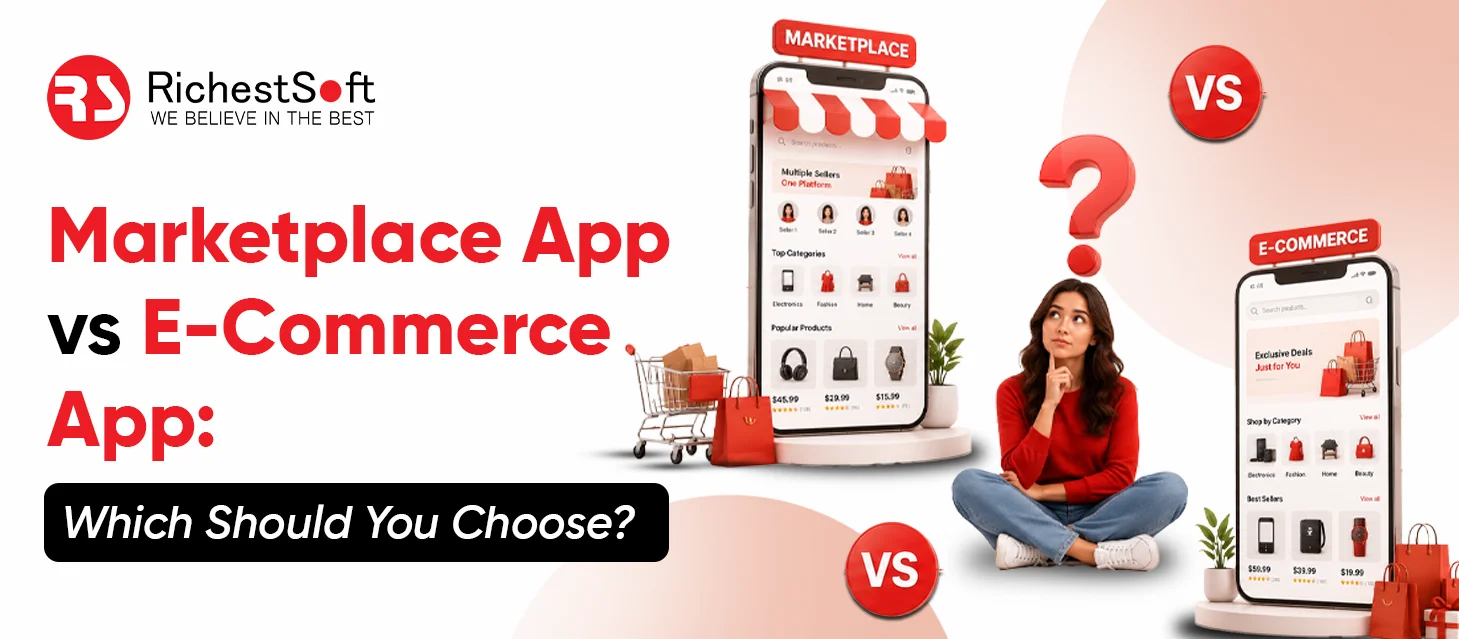
The right choice depends on what you want to sell, how you want to earn money, and how you plan to grow your business. Neither model is better for every business.
Choose a Marketplace App If:
A marketplace is a better option if you want to create a platform where different businesses or sellers can sell their products.
A marketplace may be right for you if:
- You want multiple sellers on one platform.
- You plan to earn through commissions.
- Sellers need their own accounts and dashboards.
- You want to offer products from different businesses.
- You plan to grow by adding more sellers.
- You need features for seller and order management.
Choose an E-Commerce App If:
An e-commerce app is more suitable when a business runs in B2C mode.
An e-commerce app may be right for you if:
- You sell your own products.
- You want full control over pricing and inventory.
- You do not need multiple sellers.
- You want to build a single-brand shopping app.
- You want a simpler business model.
- You want to manage customers and orders directly.
In Simple Terms
If you want to connect multiple sellers with customers, choose a marketplace app. If you want to sell your own products directly to customers, an e-commerce app is usually the better choice.
Quick decision tips:
- Multiple sellers → Marketplace app
- One main seller → E-commerce app
- Commission-based model → Marketplace app
- Direct product sales → E-commerce app
Why Choose RichestSoft for App Development?
Building an e-commerce app or marketplace takes more than adding products and payment methods. You need the proper features, a pleasant user experience, secure payments, and a platform that grows with your company. That’s exactly when RichestSoft helps! We build marketplace and e-commerce software for companies with specific purposes.
Custom App Development
RichestSoft builds apps around your specific requirements instead of using the same solution for every business.
You get:
- Custom UI/UX design
- Business-specific features
- Scalable app architecture
- User-friendly interfaces
Marketplace App Expertise
For businesses planning a multi-vendor platform, RichestSoft can develop features that make it easier to manage sellers and customers.
Key capabilities include:
- Seller registration and dashboards
- Product and order management
- Commission management
- Reviews and ratings
- Admin controls
E-Commerce App Development
RichestSoft can also develop e-commerce apps that help businesses sell their products directly to customers. As a professional e-commerce app development company, RichestSoft focuses on creating scalable and user-friendly solutions based on each business’s specific requirements.
The app can include:
- Product catalogs
- Shopping carts
- Wishlist
- Secure checkout
- Payment integration
- Order tracking
- Inventory management
End-to-End Development Support
RichestSoft supports the project from the initial idea to launch and ongoing improvements.
Our support includes:
- Business planning
- UI/UX design
- App development
- API integration
- Testing and deployment
- Maintenance and updates
Build a Scalable Shopping App with RichestSoft.
Build a Scalable Shopping App with RichestSoft.
Conclusion
Still unsure whether to build a marketplace app or an e-commerce app? Consult with RichestSoft!
We have expertise in developing marketplace and e-commerce applications, and we assist companies in planning, designing, creating, and launching bespoke apps with the functionality they require.