+1 315 210 4488
 +91 99888 06489


May 6, 2026
The ride-hailing industry has evolved into a high-growth, on-demand business model that continues to attract strong investment and user demand worldwide. Platforms like Uber and Bolt have set clear benchmarks for how scalable mobility solutions can generate consistent revenue while solving real customer needs.
For businesses planning to enter this space, the decision is no longer about launching a ride-hailing app—it’s about choosing the right business model that can compete and sustain growth. And if you are confused between which app to invest in, whether Bolt or Uber, understanding the differences they have is essential for making the right investment decision. That’s exactly why we have created this post!
Below, you will find a detailed breakdown of Bolt vs Uber, like how both platforms differ. We will also help you choose which type of ride-hailing app aligns better with your business goals in 2026.
Transform Your Taxi Business with a Custom Mobile App from RichestSoft
Transform Your Taxi Business with a Custom Mobile App from RichestSoft
Bolt vs Uber: Platform Overview for Business Decision-Makers
Uber and Bolt share ideas, but their price, growth, and market positioning change how a new ride-hailing firm should prepare. Wondering how? Explore these key details about both platforms:
Uber
Uber, a ride-hailing giant, operates in hundreds of locations. From taxi services to food delivery, freight, and logistics, it has become a multi-service platform.
Also read – How to create an app like Uber
Uber prioritizes scalability, brand positioning, and a large service ecosystem. It targets luxury and mass-market consumers with several transportation choices and dynamic pricing. This magnitude increases operational complexity and rivalry in most sectors.
Bolt
Bolt offers reduced driver commissions and competitive pricing to be more cost-effective. It has aggressively grown throughout Europe, Africa, and other developing economies by giving drivers higher pay and customers reduced costs. Create app like Bolt!
Bolt’s priorities are localized tactics, speedier market entrance, and operational efficiency. This attracts entrepreneurs and enterprises wishing to join the ride-hailing industry with a flexible and budget-friendly strategy.
Bolt vs Uber- Business Model Explained
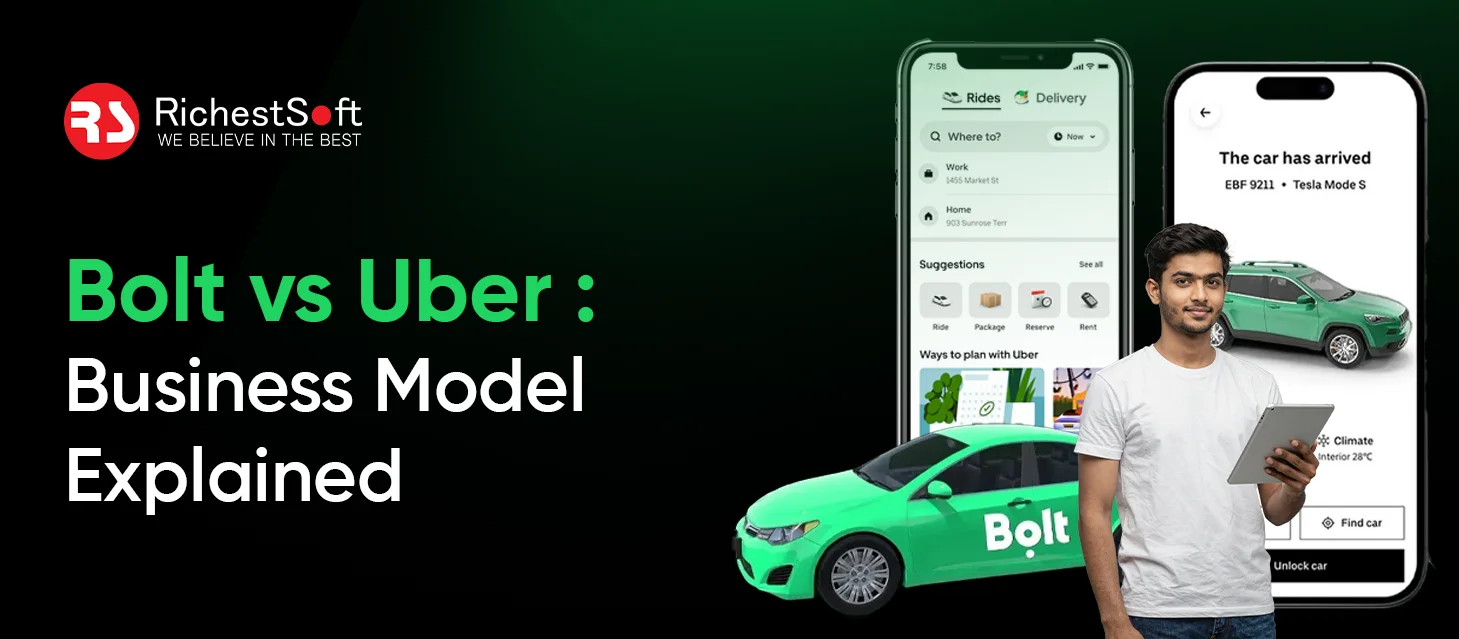
Uber and Bolt have marketplace frameworks but different pricing, implementation, and growth goals. Variations impact profitability, scalability, and market entrance and dominance quickly. Here is a detailed understanding of the Bolt vs Uber Business Model:
Uber Business Model
Uber’s global ecosystem is built on a large-scale, tech-driven marketplace approach that optimizes reach, diversifies offerings, and grows. Here is key info about Uber’s business model:
Two-sided marketplace platform
Uber links drivers and passengers through a shared platform, bridging demand and supply without owning any assets. Uber can operate in various cities without infrastructure investment using this concept. The platform can scale quickly by adding drivers and users as demand grows, making it flexible and expansion-ready.
Commission-based revenue model
Uber makes money by taking a cut of each journey. This fee changes with location, demand, and service type, enabling Uber to modify its revenues. This methodology generates constant and scalable income, particularly when ride volume rises across regions.
Dynamic pricing strategy
Uber surges fares at peak demand to balance supply and demand. This technique assures driver availability and increases earnings during peak traffic. Businesses may enhance profitability without raising operating expenses using this technique.
Multi-service ecosystem
Uber has expanded into food delivery, freight, and logistics, offering multiple revenue streams. Diversification minimizes service dependence and boosts platform value. Uber may cross-sell services to current customers, increasing client lifetime value.
Asset-light scaling model
Uber operates at cheaper costs than conventional transport companies since it does not own cars or hire drivers. This asset-light strategy speeds up market entry without investing anything. It also lets Uber prioritize technology, customer experience, and platform efficiency.
Strong brand and global positioning
A strong worldwide brand helps Uber earn consumer confidence and accelerate adoption in new areas. Brand awareness minimizes client acquisition and boosts retention. Businesses should invest in branding alongside platform development.
Bolt Business Model
Bolt has a similar marketplace framework but is more cost-effective and growth-focused. This approach attracts drivers and consumers with competitive prices and speedier market access. Here is key info about Uber’s business model:
Two-sided marketplace with multi-services
Bolt unites drivers, passengers, and delivery partners on a single platform, like Uber but simpler and more focused. It streamlines communication and simplifies the system. This keeps Bolt efficient while supplying many services.
Lower commission strategy
Bolt’s reduced commissions attract drivers. This rapidly builds a robust driving network, improving user availability. Businesses may accelerate market penetration and platform acceptance with this method.
Affordable pricing model
Bolt attracts price-sensitive passengers with cheaper transportation prices. It competes well in developing, cost-driven markets. Bolt balances reduced profitability with more utilization by keeping prices competitive and increasing ride volume.
Cost-efficient operations
Bolt keeps operations minimal by concentrating on key services and eliminating complexity. This lowers operating expenses and helps the firm profit from reduced prices. This strategy is easy to duplicate for companies with low resources.
Fast market expansion approach
Bolt targets underserved areas with little competition. It adjusts swiftly to local circumstances and price expectations, speeding adoption. Bolt can swiftly grow without competing in crowded markets with this method.
Driver-focused growth strategy
Bolt pays drivers more and lowers commissions to satisfy them. This retains drivers and strengthens platform supply. A happy driver network boosts service and customer satisfaction.
Business Model Insight
Bolt prioritizes cost-effectiveness, quick adoption, and competitive pricing. Uber has a strong focus on scalability, diversity, and revenue.
Business-wise, Bolt’s lean, cost-effective platform or Uber’s high-investment, multi-service ecosystem is the choice. Bolt grows quicker with less material.
Tips to Choose the Right Ride-Hailing Model: Bolt vs Uber
Your project approach determines whether you develop an Uber- or Bolt-like app. Both are ride-hailing platforms, but their operations, growth, and scalability vary.
So, here are some tips you must consider to choose the right riddle-hiring startup in 2026:
Scale-Focused Model vs Lean Growth Model
The goal of developing an Uber-like app is to facilitate massive operations that span several cities and services. The long-term goal is to establish a diverse ecology. On the other hand, a lean growth approach is followed by an app similar to Bolt. This model emphasizes swift market entry and gradual expansion without complicating the platform too much.
Multi-Service Ecosystem vs Focused Core Offering
In addition to providing rides, Uber also offers food delivery, logistics, and subscription services. This adds complexity while also creating many income sources. In contrast, Bolt simplifies operations by keeping its model focused on core mobility services and growing only in areas where demand is evident.
Global Dominance Strategy vs Market-Specific Expansion
Uber’s business strategy is built to take over large markets throughout the world and compete fiercely on a massive scale. In contrast, Bolt focuses on developing or less competitive markets first, establishing a solid foothold in each one before moving on to bigger and better things.
Flexibility in Operations vs. a Highly Controlled Platform
There are more rigid mechanisms for pricing, managing drivers, and delivering services on Uber’s platform. This makes things more uniform, but also makes them less adaptable. Bolt is able to respond more quickly to changes in pricing, driver onboarding, and local tactics by using more flexible technologies.
Brand-Driven vs. Efficiency-Driven Growth
Brand power, worldwide awareness, and massive marketing are the three main pillars upon which Uber’s expansion rests. By competing on the basis of value rather than brand supremacy, Bolt is able to keep expenses down and provide greater incentives to drivers.
Complex Ecosystem vs. Simple Deployment
A complicated Uber-like platform has various features, connectors, and service levels. It’s strong yet hard to handle. Simpler structures make Bolt-like models easier to start, run, and scale without technical or operational overhead.
Bolt-like models are better for rapid access, efficient operations, and strong local positioning.
Transform Your Taxi Business with a Custom Mobile App from RichestSoft
Transform Your Taxi Business with a Custom Mobile App from RichestSoft
Conclusion
One platform thrives on size and expansion, the other on efficiency and rapid development. Nevertheless, at last, all we would say is that businesses should pick the model that fits their objectives, not simply the most popular app. A well-planned strategy and business model may help your ride-hailing platform survive and profit.
RichestSoft helps here. RichestSoft’s advanced on-demand and ride-hailing experience helps companies identify the correct model, create scalable applications, and launch quicker with a solid technological basis. Their team builds your software to compete, grow, and win in a competitive market from planning to implementation.