+1 315 210 4488
 +91 99888 06489


December 4, 2025
In the 21st century, tech advancements are growing and enhancing endless business possibilities. Grocery app development is one such business opportunity that is increasingly growing among thousands of smart entrepreneurs. So, are you also looking to invest in launching such platforms, but are confused about where to begin? Don’t worry! We have compiled a list of the Top 10 Grocery Delivery Apps that have already made a strong online presence in the market.
With their notable growth and business model idea, you can create a successful platform in the market. Keep reading!

An Overview of Grocery Delivery App Development
A grocery delivery app meets the growing need for convenience. More consumers now like ordering groceries online instead of visiting stores. This trend allows entrepreneurs an opportunity to enter a market that keeps developing and expanding as more people want to reap the advantages of using a Grocery App.
A good app lets you attract customers across the globe, not just near one store. You can also create an app similar to popular brands, giving customers fast, easy, and convenient shopping.
Key benefits of developing a grocery delivery app are:
Reach more customers: Serve customers wherever they are — your delivery radius becomes your new marketplace.
Multiple ways to earn: Earn more than just product sales — delivery fees, offers, and vendor commissions boost profits.
Save time and costs: Digital workflows reduce dependency on paperwork and extra labor costs.
Use data to make smart decisions: Track what customers buy and when, then plan stock, promotions, and special offers.
Build loyal customers: Happy customers become regular customers — that’s the power of great service.
Flexible growth options: Easily widen your delivery zones or add franchise stores as the business grows.
Stay ahead of the competition: Don’t wait for competitors — build your digital presence before they do.
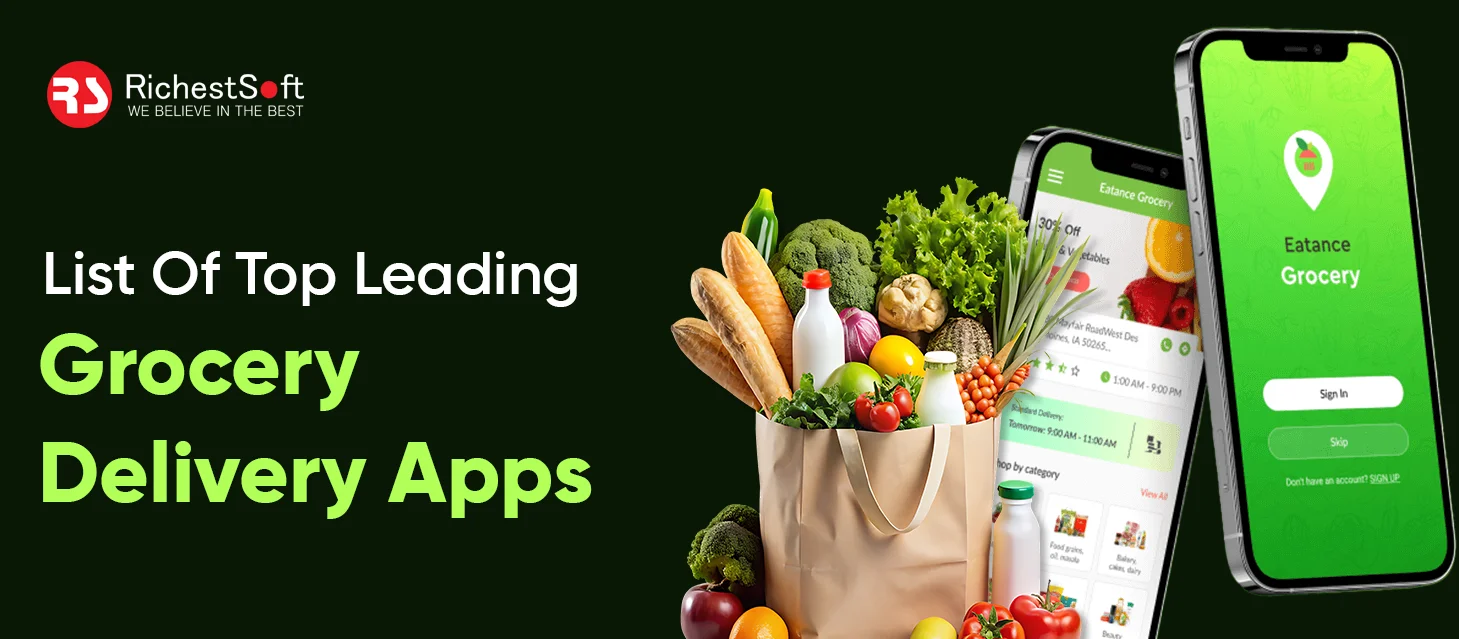
List Of Top Leading Grocery Delivery Apps
1. Amazon Fresh
Amazon Fresh combines online ease and a broad grocery range, like a large supermarket delivered to your doorstep. It uses a mix of its own stock (warehouses or fulfillment centers) and partner‑store inventory.
This hybrid approach lets it offer variety and freshness while keeping quality control. Revenue comes from product margins, delivery or service charges, and sometimes membership‑linked benefits (especially when tied to membership subscriptions).
2. Instacart
One of the top grocery delivery apps, Instacart, works like a big digital marketplace for groceries. It doesn’t hold all inventory itself; instead, it connects many retailers with customers via the app.
When a user orders, personal shoppers (gig‑economy workers) pick up items from partner stores and deliver them. This keeps upfront costs low for Instacart and lets it scale fast.
Instacart earns via retailer commissions, delivery/service fees from users, subscription fees (for frequent users), and advertising or featured listings for brands.
3. Shipt
Shipt is a delivery platform that teams up with local stores to bring groceries right to your door. Because they don’t manage warehouses, costs stay low and shoppers get plenty of variety. Their membership system also encourages repeat users and helps maintain consistent earnings.
4. Walmart Grocery (or Walmart grocery‑delivery services)
Walmart Grocery leverages the huge physical store network of Walmart, converting its existing stores into mini‑fulfillment centers to manage online orders. This keeps logistics simpler and reduces the need for new warehouses or setup. Because of the store network, it offers a wide product variety and volume buying, which helps attract budget‑conscious customers and volume buyers.
Revenue comes via product sales margin, delivery or service fees, possibly membership/subscription plan fees, and in‑store pickup or delivery services, making the cost per order relatively low and margins manageable.
5. FreshDirect
FreshDirect follows an inventory‑led model: it owns and manages stock directly. It stores groceries, fresh produce, meats, seafood, and delivers them from its warehouse to customers.
This control over inventory gives strong assurance on freshness and quality, valuable for customers willing to pay for premium service.
Revenue comes from product markup (since FreshDirect sources wholesale and sells retail), delivery fees, and possibly repeat customers who value reliability and quality of delivery.
6. GoPuff
GoPuff works like a “micro‑fulfillment + instant‑commerce” model: it buys and stocks items itself, groceries, essentials, snacks, and convenience items, then delivers them fast from its small warehouses to customers.
This gives full control over supply and delivery, and the ability to promise rapid delivery (often within 30 minutes), which matches demand for convenience and on‑the‑spot needs.
Revenue comes via product margin (since you own stock), delivery fees, and often slightly higher prices for convenience or faster delivery, which can be more profitable in dense urban zones.
7. DoorDash (with grocery / retail delivery)
DoorDash originated as a restaurant-food delivery company, but expanded to grocery and retail goods too, using the same delivery network and logistical architecture.
This growth works because their existing fleet, routing infrastructure, and logistics know‑how can handle more than simply food, decreasing the cost per delivery type.
Revenue comes from delivery or service fees, commissions from partner stores, and perhaps extra charges for faster or priority delivery services. This model suits entrepreneurs who don’t want to handle inventory but want variety and flexibility.
8. Uber Eats (with grocery/retail expansion)
Uber Eats, originally a food‑delivery service, leverages the enormous driver and logistical network of its parent firm, which helps expand into grocery and retail without building a totally new infrastructure.
Using its ride‑share / delivery fleet, already built for meal delivery, Uber Eats tapped into grocery delivery demand with lower marginal cost.
Revenue comes via commissions on orders, delivery fees, and by mixing different product types (groceries, meals, retail items), the app increases chances for frequent use and better order volume, good for scaling.
9. Postmates
Postmates was one of the first apps to offer delivery for almost anything — food, groceries, convenience items, and more. It acted as a flexible marketplace connecting customers, stores, and delivery partners, without owning inventory. This model lets Postmates serve many types of customers and meet different needs, giving it a large market to reach.
10. Safeway Online Grocery
Safeway blends its strong physical supermarket presence with online grocery delivery. Instead of constructing brand-new warehouses, this hybrid model enables the business to use its current store infrastructure for fulfillment.
Product sales margins, delivery or service costs, and optional membership or loyalty programs (like FreshPass) for regular customers are the sources of revenue. This strategy helps produce reliable recurring income while minimizing logistics overhead.
Cost To Build A Grocery Delivery App
The cost to build a grocery delivery app can vary widely. For a basic version with essential features (product list, cart, payments, checkout, order tracking), development usually costs around $15k–$30k.
For a more complete, mid‑level app- with smoother UI, payment integration, push notifications, and support for multiple vendors or delivery partners- you might spend about $30k–$70k. If you aim for a full‑feature enterprise‑grade platform with advanced capabilities (scalable backend, multi‑city support, analytics, loyalty programs, possibly AI/recommendations), cost may rise to US $80k–$150k or more.
Hidden costs include hosting, third‑party integrations (payment gateways, GPS/maps, notifications), ongoing maintenance, updates, and scaling, which together can add a high yearly cost.
Final Notes
At last, all we would say is that investing in a grocery delivery app development is a wise decision. It helps businesses reach more customers, establish loyalty, and grow their brand.
That is when Richestsoft, the Top Grocery Delivery App Development Company, can be your reliable partner. We handle everything from idea to launch, ensuring you build a platform that scales in the market.
FAQ’s
- Q. How much does it cost to build a grocery delivery app?
A starter grocery app usually ranges between $15–25K. For enhanced functionality, it can reach $50–100K+.
- Q. What extra costs should I expect after the app is built?
Post-launch costs include infrastructure hosting and regular improvements — commonly 15–25% of the original cost each year.
- Q. Does building for Android and iOS both cost more than just one platform?
Yes — supporting both platforms means more work, so the budget increases.
- Q. Can I start with a small budget and build gradually?
Absolutely! You can launch a basic MVP first, then add features as your app grows.
- Q. What kind of features raise the cost significantly?
Real-time tracking, multiple vendor setup, secure payments, and custom UI are big cost-adders.
- Q. Is maintenance a high ongoing cost after launch?
Yes, maintenance is essential — covering updates, server handling, and bug fixes yearly.