+1 315 210 4488
 +91 99888 06489


January 23, 2026
Choosing the right technology for iOS development is no longer just a “developer decision.” It’s a business decision, one that directly impacts your budget, speed to market, scalability, and long-term maintenance.
If you’re evaluating Flutter vs Swift app development, you’re probably asking questions like:
- Will this scale as my business grows?
- How fast can I launch?
- Which option gives better ROI?
This blog breaks down the differences in a clear and honest way, without buzzwords or hype.
Understanding the Basics
At a high level, the debate is simple:
- Swift is Apple’s native language, built specifically for iOS.
- Flutter is a cross-platform framework that lets you build apps for iOS and Android using a single codebase.
But the real difference isn’t technical; it’s strategic.
Flutter vs Swift App Development: Comparison Based on Key Factors
1. Development Speed
With Flutter, developers can build iOS apps more easily since one codebase works for both platforms. Features such as hot reload cut down on iteration time, allowing for rapid releases.
Swift, however, needs platform-specific development, which might result in a longer delivery time, but it also promises native accuracy.
2. Performance & App Responsiveness
Swift runs right on top of Apple’s ecosystem architecture, so you get native performance. That’s why it is best suited for high-performance applications.
Flutter has almost native performance, and it fits the majority of business applications, but some very complex tasks could still be done in Swift.
3. Cost Efficiency
Flutter reduces development and maintenance costs significantly by sharing the code between multiple platforms.
Generally, Swift development has a higher upfront cost as iOS apps have to be developed and maintained separately.
4. UI & User Experience
Flutter offers great customization, so the UI can be consistent across devices, without sacrificing creative freedom.
Swift uses native UIKit and SwiftUI elements, giving you Apple-standard UI and system-consistent behavior.
5. Platform Scalability
Flutter is perfect for businesses that are looking to grow beyond iOS into Android, web, or desktop.
Swift is primarily for iOS-only apps that have no cross-platform plans.
6. Long-Term Maintenance & Updates
Flutter facilitates long-term maintenance as its updates roll out across all platforms at the same time.
Swift provides stability and long-term support in the Apple ecosystem, and it is also the first to be supported with new iOS capabilities.
Flutter vs Swift App Development: Quick Comparison
This table alone explains why the Flutter vs Swift app development conversation exists in the first place.
| Factor | Flutter | Swift |
|---|---|---|
| Platform Support | iOS, Android, Web, Desktop | iOS-only |
| Codebase | Single codebase | Separate iOS code |
| Performance | Near-native | Fully native |
| Development Speed | Faster | Slower |
| Cost Efficiency | Higher | Lower |
| UI Flexibility | Very high | Native-focused |
| Apple Feature Access | Via plugins | Immediate |
| Best Use Case | Cross-platform growth | iOS-first products |
Benefits of Flutter App Development
Flutter isn’t just popular; it’s popular for multiple reasons:
1. You Want to Launch Faster
If speed matters (and it usually does), Flutter wins. One codebase means:
- Faster development
- Faster testing
- Faster deployment
This is a major advantage for startups, MVPs, and businesses validating ideas quickly.
2. You Need iOS and Android
If your roadmap includes Android — now or later — Flutter saves time and money. Instead of building two separate apps, you build once and scale everywhere.
This is why many companies opt for Flutter vs Swift app development services when growth is the priority.
3. You Want Predictable Costs
Flutter reduces:
- Development hours
- Team size
- Maintenance complexity
Among cost-conscious businesses, this typically translates to higher ROI with no compromise on quality.
Real-world example: An eCommerce company such as Alibaba bringing a mobile app to iOS and Android using a shared design system will quite likely gain the most advantages with Flutter.
Benefits of Swift App Development
Swift isn’t outdated or slow — it’s precise and powerful.
1. You’re Building an iOS-Only Product
If your product lives exclusively in Apple’s ecosystem, Swift is hard to beat. It gives you:
- Full access to Apple APIs
- Maximum performance
- Long-term stability
2. Performance Is Mission-Critical
Apps that rely on:
- Heavy animations
- Augmented Reality
- Core ML or advanced system-level features
perform best with native Swift development.
3. You Want Apple-First Innovation
Apple releases new features to Swift developers first. If staying ahead of iOS updates matters to your product, Swift keeps you future-ready.
Real-world example: A healthcare app like MyChart that prioritizes security, device-level integrations, and performance usually benefits from Swift.
What to Choose: Flutter vs Swift?
Flutter is very fast, and for almost all types of business applications, end users are not able to find any difference. The UI is snappy, animations are smooth, and load times are on par.
However, Swift still wins when:
- Every millisecond matters
- You’re pushing hardware limits
- You rely heavily on Apple-specific frameworks
Latest Trends: Where Flutter and Swift Are Headed
Flutter Trends
- Strong focus on performance optimization
- Reduced app size
- Better desktop and web support
- Increased enterprise adoption
Flutter is no longer “just for startups.” Many large companies now use it for production-grade apps.
Swift Trends
- SwiftUI adoption is accelerating
- Cleaner async programming with async/await
- Strong push toward declarative UI development
Swift continues to evolve as Apple’s long-term vision for iOS development.
Cost Comparison: Flutter vs Swift App Development Services
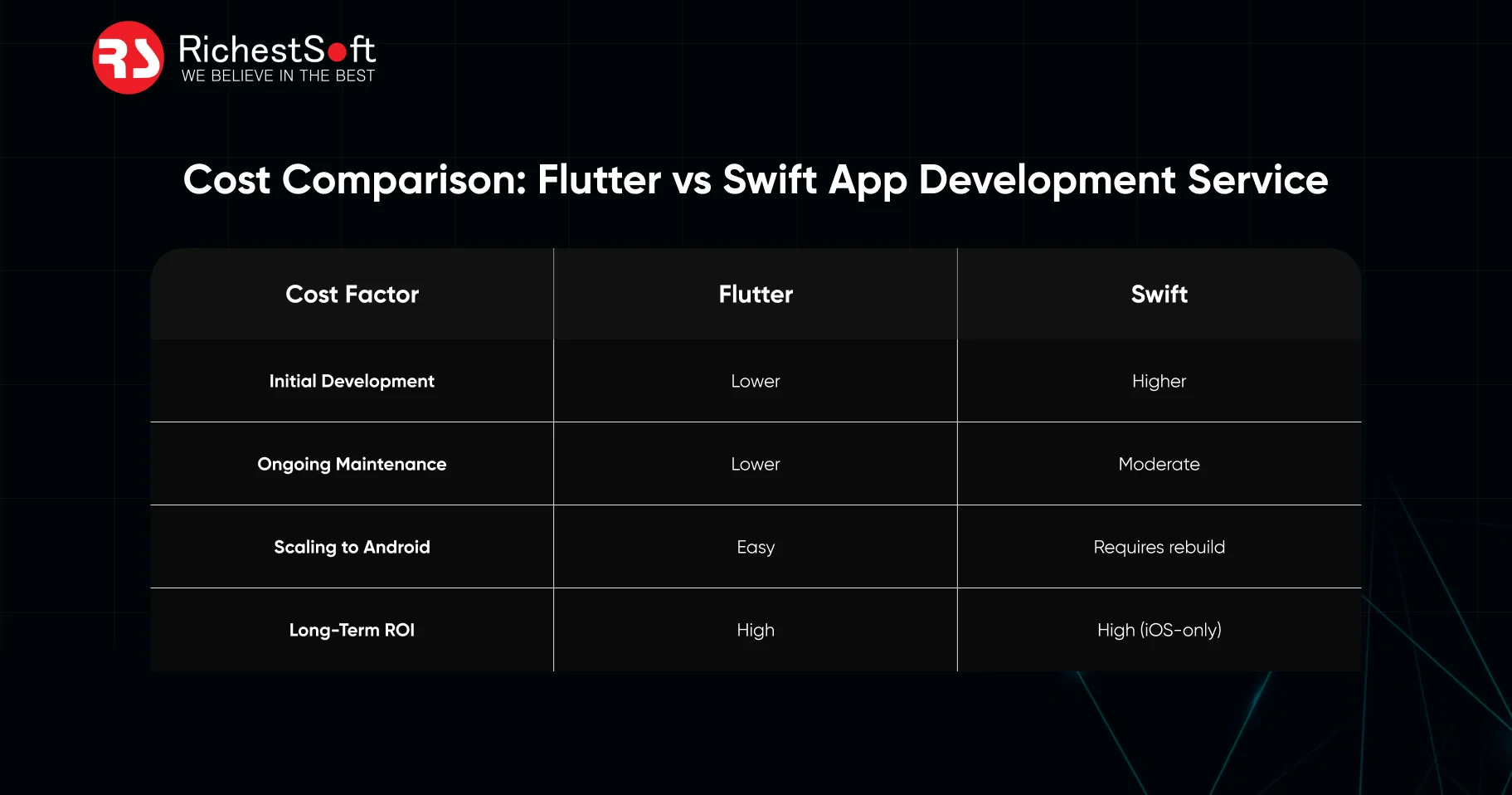
Flutter often wins on short- to mid-term cost efficiency, while Swift excels in long-term iOS specialization.
How RichestSoft Helps You Choose the Right Path
At RichestSoft, we don’t push a framework; we solve business problems.
- If your goal is faster launches and wider reach, our Flutter app development company delivers scalable solutions.
- If you need deep iOS performance and native excellence, hire Swift app developers to build robust, future-proof apps.
That’s why clients looking for the best Flutter vs Swift developers trust us — we recommend what fits your product, not what’s trending.
Final Thoughts
The Flutter vs Swift debate doesn’t have a single winner — and that’s a good thing.
- Choose Flutter if growth, speed, and cost efficiency matter.
- Choose Swift if performance, native features, and iOS focus matter.
The smartest move? Work with a team that understands both — and knows when to use each.
That’s where RichestSoft comes in.
FAQs
Is Swift being replaced by Flutter for iOS development?
No, Flutter is a complement to Swift, not a replacement.
What is better for startups?
Flutter is better in most cases, for speed and cost-effectiveness.
Can Flutter apps feel native on iOS?
Yes, most people cannot tell the difference.
What is easier to maintain long-term?
Flutter – for multi-platform apps, Swift – for iOS-only apps.