+1 315 210 4488
 +91 99888 06489


July 16, 2026
An AI agent is an autonomous software system that uses an AI model (like a Large Language Model) to understand goals, make decisions, and take multi-step actions. Unlike a standard chatbot that just answers prompts, an agent performs complex tasks without constant human intervention.
Want to know how? Keep reading this post! We have shared a detailed guide on what exactly AI agents are and how they work.
Build Intelligent AI Agents for Your Business with RichestSoft
Build Intelligent AI Agents for Your Business with RichestSoft
What Is an AI Agent?
An AI agent is a system that can think, plan, and take action on its own to complete a goal- not just respond to a question.
Here’s what makes it different from a regular chatbot:
- A chatbot answers, then waits. It only responds when you ask something.
- An AI agent acts on its own. You give it a goal, and it figures out the steps to reach it.
- It can use tools. Search the web, pull data, or connect to other systems without being told exactly how.
- It works in multiple steps. It plans, takes action, checks the result, and adjusts if needed- without you guiding each step.
Simple example: If you ask a chatbot for tomorrow’s weather, it just tells you. If you give an AI agent the goal “find the best day for surfing next week,” it checks multiple sources, compares conditions, and gives you a final answer- on its own.
How AI Agents Work: The Core Cycle
AI agents work in a continuous cycle to complete tasks and attain goals. This cycle enables them to perform difficult tasks with no human involvement.
1. Perceive: Gather Information
The first step is understanding the situation. AI agents collect information from sources such as:
- User requests
- Databases
- Business systems
- Websites and search tools
- Sensors and devices
Consider this example: When a consumer inquires about an order, the agent gets the order details before proceeding.
2. Reason and Plan: Decide the Best Action
Once it has the information, the agent analyzes it and builds a plan. At this stage, it:
- Understands the goal
- Breaks the task into smaller steps
- Weighs the available options
- Decides on the best course of action
For instance, when a user books a flight, the agent explores choices, compares costs, and chooses the best one.
3. Act: Execute the Task
With a plan ready, the agent carries out the necessary actions. Depending on the task, this could include:
- Searching for information
- Sending messages
- Updating records
- Generating content
- Calling APIs
- Completing transactions
This ability to actually take action- not just provide an answer- is what separates AI agents from traditional chatbots.
4. Learn and Improve: Use Feedback
Some agents get better over time by learning from outcomes. They can:
- Track what worked
- Identify mistakes
- Adjust future decisions
- Improve accuracy and efficiency
For example, a customer support agent might learn which solutions resolve issues fastest, and apply that insight in future conversations.
5. The Cycle Repeats Continuously
AI agents don’t stop after one action; they repeat the cycle-
- Perceive
- Reason
- Act
- Learn
This ability to reason and act across multiple steps is what makes AI agents more capable than traditional automation.
Core Components of an AI Agent
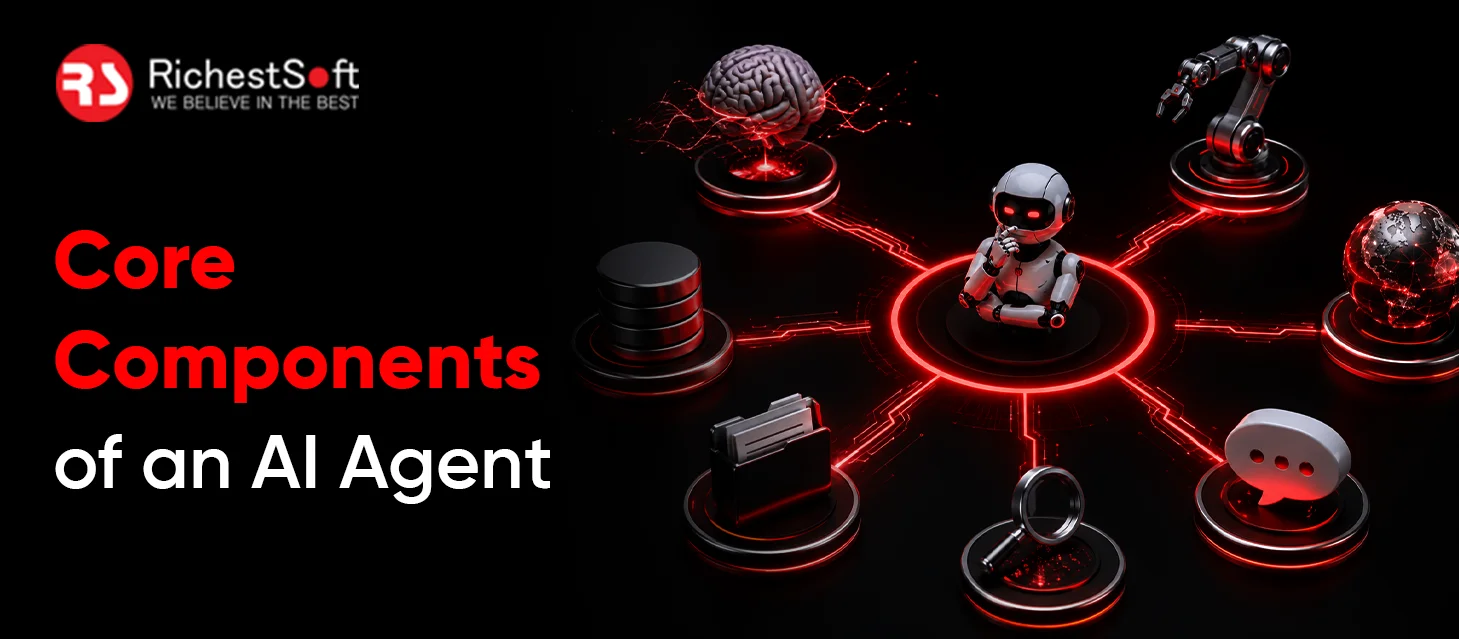
Several parts work together to make an AI agent function. Here’s what each one does:
Input Layer
This is how the agent takes in information. Sources include:
- Text prompts
- Images
- Sensor data
- Business records
Reasoning Engine
This is the agent’s decision-making system. It:
- Interprets information
- Weighs the available options
- Decides what to do next
Most modern AI agents use a large language model as their reasoning engine.
Tools and Integrations
Agents connect to external tools to do more than just generate text. Common integrations include:
- Search engines
- APIs
- Databases
- CRM systems
- Analytics platforms
These tools let an agent actually complete tasks, not just describe them.
Memory
Memory lets an agent keep track of context across interactions. It’s used to:
- Track ongoing conversations
- Store user preferences
- Keep tabs on multi-step tasks
- Make smarter decisions based on past interactions
Output Layer
This is how the agent delivers results or takes action. Examples include:
- Generating a response
- Sending a notification
- Updating a record
- Completing a workflow
Types of AI Agents
Not all AI agents work the same way. Here are the main types, from simplest to most advanced:
Simple Reflex Agents
These agents follow fixed, predefined rules. They:
- React directly to specific inputs
- Use basic if-then logic
- Don’t store any memory
They’re reliable for simple, repetitive tasks but struggle with anything unpredictable.
Model-Based Agents
These agents keep an internal sense of their environment. They can:
- Factor in previous information
- Track changes over time
- Make more informed decisions than a simple reflex agent
This makes them better suited to situations that change or evolve.
Goal-Based Agents
These agents are built around achieving a specific outcome. Rather than just reacting to what happens, they:
- Evaluate different possible actions
- Choose the ones that move them closer to the goal
Learning Agents
These agents get better over time through experience. They:
- Analyze past results
- Identify patterns
- Refine how they act in the future
The more they interact with their environment, the more effective they become.
Single-Agent vs. Multi-Agent Systems
- Single-agent systems- one agent handles the entire task on its own
- Multi-agent systems- multiple agents work together and do the following tasks-
- Share information
- Divide tasks between themselves
- Coordinate decisions
- Solve complex problems as a team
Real-World Examples of AI Agents
Many sectors use AI agents to automate activities, improve efficiency, and make decisions. While the technology evolves, many businesses use AI agents daily without recognizing it.
Here are some real-world examples of AI agents:
AI Coding Assistants
AI coding agents help developers write, review, and improve software more efficiently.
Common tasks include:
- Generating code suggestions
- Identifying bugs and errors
- Explaining complex code
- Automating repetitive development tasks
Customer Service Agents
Many businesses use AI agents to handle customer support requests and improve response times.
Common tasks include:
- Answering customer questions
- Retrieving account information
- Resolving common support issues
- Escalating complex cases to human agents
Sales and Marketing Agents
AI agents can support marketing and sales teams by automating routine activities.
Common tasks include:
- Lead qualification
- Customer follow-ups
- Email personalization
- Campaign performance analysis
Supply Chain and Operations Agents
Businesses use AI agents to monitor operations and improve efficiency across logistics and supply chains.
Common tasks include:
- Inventory monitoring
- Demand forecasting
- Route optimization
- Shipment tracking
Personal AI Assistants
Consumer AI assistants are becoming more capable of helping users manage daily activities.
Common tasks include:
- Scheduling meetings
- Managing calendars
- Setting reminders
- Organizing information
Autonomous Vehicles
Self-driving vehicles are among the most advanced examples of AI agents operating in the physical world.
Common tasks include:
- Monitoring surroundings
- Detecting obstacles
- Planning routes
- Making real-time driving decisions
Multi-Agent Business Systems
Some organizations use multiple AI agents that work together to complete larger workflows.
Common tasks include:
- Research and data collection
- Content creation
- Report generation
- Process automation across departments
Build Intelligent AI Agents for Your Business with RichestSoft
Build Intelligent AI Agents for Your Business with RichestSoft
Conclusion
Ready to explore AI-powered solutions for your business? Connect with RichestSoft today! We provide the best AI agent development services, helping businesses build intelligent AI-powered solutions that support:
- Workflow automation
- Customer experience
- Business Growth
Call us today!