+1 315 210 4488
 +91 99888 06489


July 1, 2026
Building a dark store and hyperlocal delivery platform requires the right technology to manage orders, inventory, deliveries, and customers in real time. The best platforms offer features like live inventory tracking, smart delivery routing, secure payments, and location-based order management to deliver products quickly and efficiently.
In this post, we share a detailed guide on building a Dark Store and Hyperlocal Delivery Platform.
Start Your Dark Store and Hyperlocal Delivery Platform Development with RichestSoft
Start Your Dark Store and Hyperlocal Delivery Platform Development with RichestSoft
What Is a Dark Store and Hyperlocal Delivery Platform?
A dark store and hyperlocal delivery platform is a technology-driven solution that helps businesses deliver products to nearby customers in the shortest possible time. A dark store functions as a dedicated fulfillment center that processes only online orders, while the hyperlocal delivery platform manages ordering, inventory, logistics, and last-mile delivery within a limited geographic area.
To operate efficiently, a dark store and hyperlocal delivery platform consist of several connected applications and management systems that work together in real time.
Customer App
- Allows users to browse products easily
- Lets customers place orders from mobile devices
- Supports secure online payments
- Provides real-time delivery tracking
- Sends order confirmation and delivery notifications
Dark Store Management Panel
- Helps warehouse staff manage inventory
- Receives and organizes new orders
- Generates picking lists for faster packing
- Updates stock availability in real time
- Prepares orders for dispatch efficiently
Delivery Partner App
- Sends delivery requests to drivers
- Provides optimized delivery routes
- Helps drivers navigate to customer locations
- Updates delivery status in real time
- Captures proof of delivery
Admin Panel
- Gives business owners full platform control
- Manages users, dark stores, and products
- Handles pricing and promotional offers
- Oversees delivery operations and payments
- Tracks business performance through analytics
Backend & Logistics Engine
- Works as the central system connecting all apps
- Synchronizes inventory across the platform
- Processes and manages customer orders
- Handles payment processing securely
- Assigns deliveries to the nearest dark store
- Routes orders for faster fulfillment
Step-by-Step Process for Dark Store and Hyperlocal Delivery Platform Development
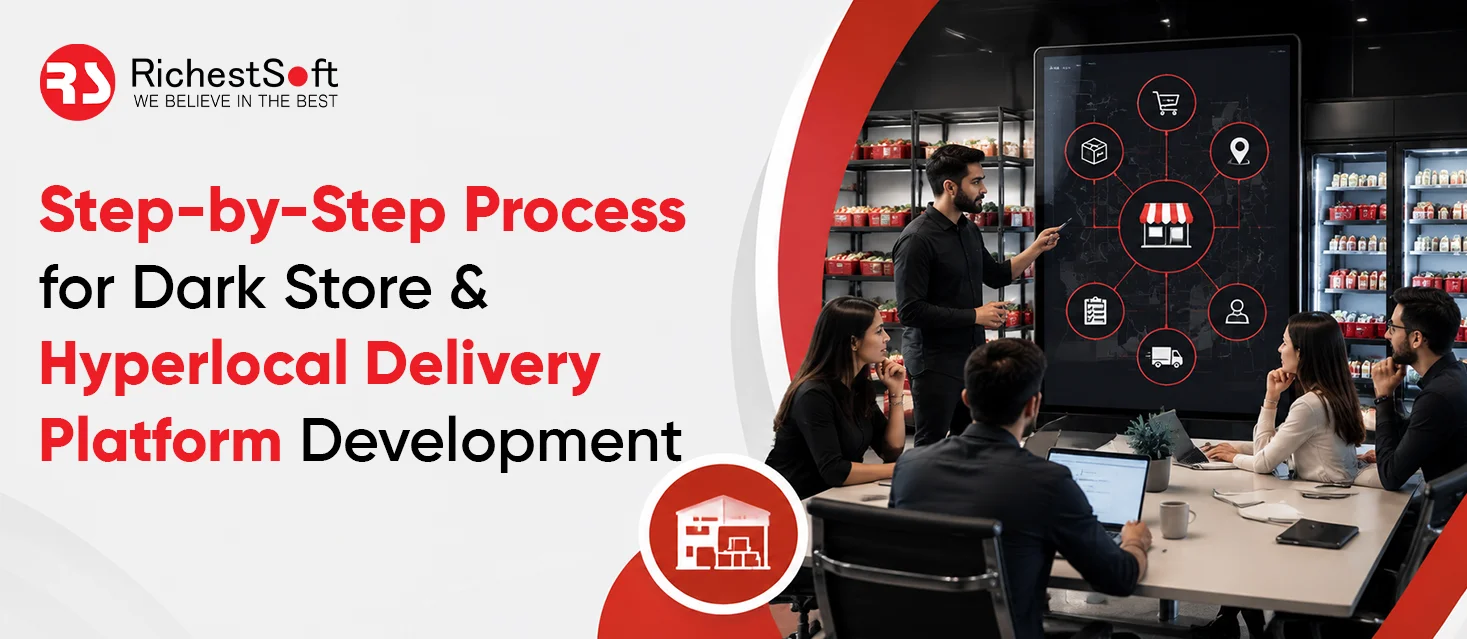
Right conceptualization, feature-technology integration, and maintaining its scalability are essential components for successful Dark Store and Hyperlocal Delivery Platform Development. Every step contributes to a seamless platform for consumers, shop management, and delivery partners. Here is a simple step-by-step process to build a high-functioning platform:
Stage 1: Plan Your Business Requirements
A business strategy underpins every successful platform. Before development, you must set objectives, identify clients, and plan your platform. Planning reduces development costs and ensures the result satisfies corporate requirements.
Define Your Business Model
Begin by planning the business model. Choose between managing your own dark shops, partnering with local retailers, or a hybrid option. Your business model affects platform features and development.
Understand Your Target Audience
Find out what your target audience wants from your platform. Understanding their shopping habits, product preferences, and delivery expectations improves customer experience.
Research Your Competitors
Study alternative hyperlocal delivery services’ pros, cons, and features. This helps you find ways to improve services and stand out.
Finalize Your Platform Features
List crucial features like order management, inventory monitoring, delivery tracking, numerous payment choices, and customer assistance.
Set a Budget and Timeline
Determine your development budget and timeline. Project delays can be avoided with a reasonable budget and timetable.
Stage 2: Design the Platform
After planning, create an easy-to-use platform. A simple and easy design encourages consumers to order and helps shop management and delivery partners work smoothly.
Simple Customer Experience Design
Provide a clear interface for users to explore, purchase, pay, and monitor delivery.
Build Separate Dashboards
Create dashboards for administrators, store managers, and delivery partners. Each dashboard should show just the user’s role-specific tools and information.
Focus on Mobile-Friendly Design
Most clients purchase by smartphone. Create Android- and iOS-friendly mobile-first interfaces.
Create Easy Navigation
Simple menus, categories, search options, and checkout procedures let consumers locate and buy things.
Develop Interactive Prototypes
Create wireframes and interactive prototypes before development. This lets you test and optimize the user experience early.
Stage 3: Develop the Core Platform
This is where your platform forms. Developers create apps, connect technology, and add features to manage delivery.
Create Customer, Admin, and Delivery Apps
To make task easier for consumers, administrators, store managers, and delivery partners, create separate apps.
Add Real-Time Inventory Management
Integrate your platform with inventory management systems to show customers product availability and stock levels.
Add Secure Payment Options
Use reliable payment channels for credit, debit, digital wallets, UPI, and cash on delivery.
Implement GPS and Delivery Tracking
Allow real-time location monitoring so consumers can follow orders and companies can optimize delivery routes.
Build Smart Order Management
Create an automated order confirmation, dispatch, alerts, and status update system.
Stage 4: Test and Optimize the Platform
Each feature should be thoroughly tested before platform launch. Proper testing identifies errors in early stages, boosts speed, and makes user experience seamless.
Test Every Feature
To confirm functionality, test product search, checkout, payments, inventory changes, alerts, and delivery tracking.
Improve Speed and Performance
Optimize your platform for fast page loads and action completion, even under heavy traffic.
Ensure Mobile Compatibility
For a consistent user experience, test the platform on numerous devices, screen sizes, and operating systems.
Enhance Platform Security
Use secure authentication, encrypted payments, and frequent security testing to protect consumer data.
Fix Bugs Before Launch
Find and fix technical bugs during testing before releasing the platform.
Stage 5: Launch, Monitor, and Scale Your Platform
Launching your platform is only the start. Performance, customer satisfaction, and long-term company growth all depend on continuous monitoring and adjustments.
Launch on Multiple Platforms
Publish Android, iOS, and web apps so your target audience can use your service app from any device.
Monitor Platform Performance
Monitor order volume, delivery timeframes, customer activity, and application performance to improve.
Collect Customer Feedback
Learn what customers appreciate and what needs improvement from consumer evaluations and ideas.
Release Regular Updates
Based on user input and market needs, add features, enhance functionality, and address concerns.
Expand as Your Business Grows
To accommodate expansion, add new service regions, dark shops, delivery partners, and sophisticated capabilities as your client base grows.
Start Your Dark Store and Hyperlocal Delivery Platform Development with RichestSoft
Start Your Dark Store and Hyperlocal Delivery Platform Development with RichestSoft
Conclusion
Planning to build a dark store and hyperlocal delivery platform for your business?
At RichestSoft, we specialize in developing custom dark store and hyperlocal delivery platforms tailored to your business model. From strategy and UI/UX design to app development, logistics integration, and post-launch support, our team delivers secure, scalable, and future-ready solutions that help businesses grow with confidence.