+1 315 210 4488
 +91 99888 06489


April 27, 2026
Building a food delivery platform like Talabat is a business opportunity that combines marketplace architecture, real-time logistics, and high-volume transaction processing. This model operates on a three-sided system—customers, restaurants, and delivery partners—where seamless coordination and system performance directly impact revenue and user retention.
However, if you want to be successful, you need the right business strategy and expert support. So, wondering how to make a Talabat-like app and build a sustained market dominance?
In this blog, we have shared a detailed guide on a complete development roadmap for building a food delivery app like Talabat.
Launch Your Food Delivery App Like Talabat in Weeks with RichestSoft
Launch Your Food Delivery App Like Talabat in Weeks with RichestSoft
About the Original Platform & Business Model – Talabat UAE
Talabat is the Middle East’s on-demand delivery platform that delivers food, groceries, and more. It’s an organized, technology-led marketplace that links consumers, restaurants, and delivery partners in real time, revolutionizing food delivery ecosystems. High-frequency transactions, excellent logistical coordination, and strong partner integration generate value in Talabat’s multi-sided digital ecosystem. Its business strength is scaling demand and supply on a single platform, not only food delivery.
Talabat UAE works on these business models:
Marketplace-Based Revenue Model
Customers, eateries, and delivery riders are all brought together in Talabat’s marketplace. The platform can easily handle an increase in transaction volume since the majority of revenue is produced by commissions imposed on each order.
Restaurant Commissions
Each order that a partner restaurant receives via the platform is offset by a percentage charge. This concept establishes a performance-based revenue stream for the platform by guaranteeing that revenue increases in direct correlation to restaurant activity.
Deliver Fee Monetization
Delivery fees are determined by factors such as distance, demand, and order value and are charged to customers. This not only pays for the logistics, but it also offers a steady stream of income that isn’t reliant on commissions from restaurants.
Logistics and Delivery Network Efficiency
Managed delivery is a significant operational competency. Talabat optimizes operating costs, customer happiness, and delivery speed by coordinating riders using technology.
Promo/Ad Revenue
Restaurants and companies may buy app features, sponsored placements, and promotional exposure. This generates high-margin income beyond order commissions.
Data-Driven Business Optimization
The platform optimizes operations, pricing, and restaurant relationships using user data, ordering patterns, and demand trends. This boosts platform profitability and efficiency.
Steps to Create a Food Delivery App Like Talabat
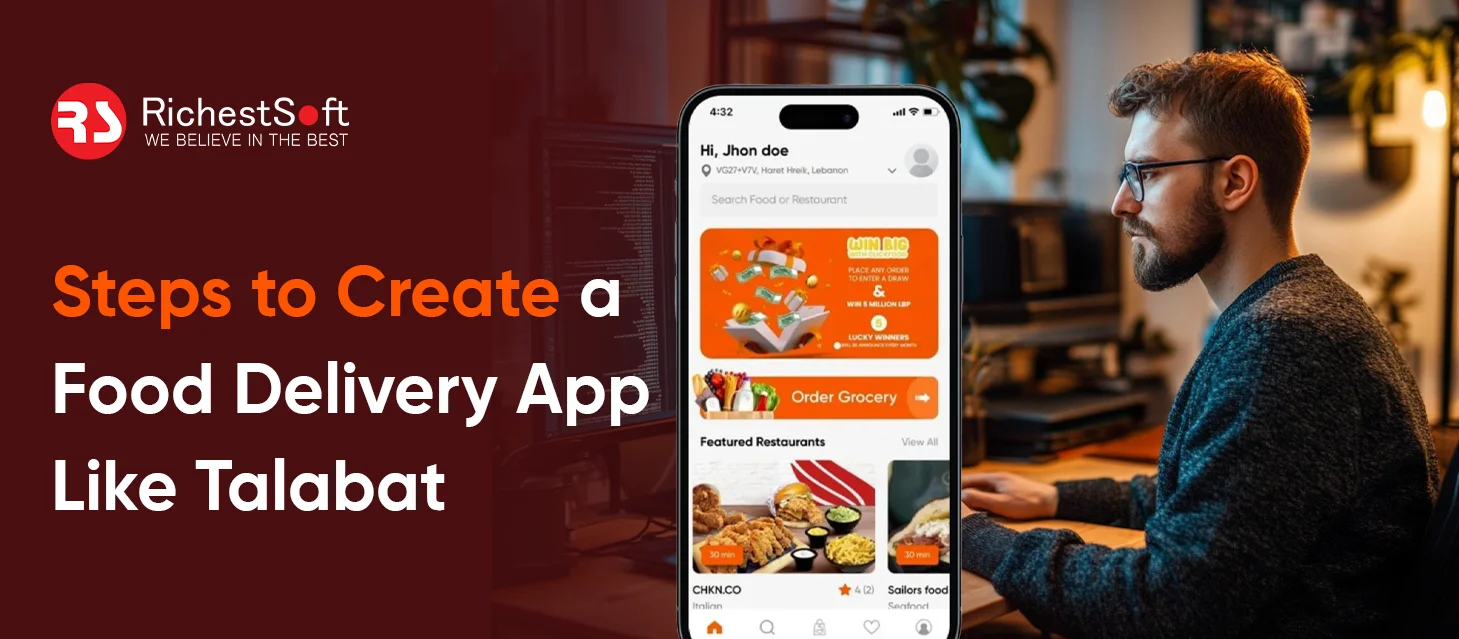
Building a food delivery platform like Talabat UAE requires smart business planning and execution. Want to know what it’s like? Explore these key development steps:
Define Business Model & Target Market
The platform is built on this. You must identify your clients, geographies, and market gaps. Along with this, decide on your income model—commission, delivery charge, subscription, or hybrid.
Early expansion plan selection is crucial. Some enthusiasts start city-by-city, while others intend for multi-city scalability. A defined business model guarantees every technological and operational choice promotes long-term development and profitability.
Plan Platform Core Architecture
The backend architecture of a complicated multi-sided food delivery software like Talabat must be scalable and real-time. This comprises API and data flow interactions between users, restaurants, and delivery partners.
Effective planning at this step ensures smooth order processing, minimal downtime, and platform traffic flexibility. System breakdowns, delays, and poor user experience may come from faulty architecture.
Build Essential App Modules
For various users, the platform has to be partitioned into distinct yet interconnected modules:
- Consumer software for perusing, placing orders, and making payments
- Menu, price, and order management dashboard for restaurants
- Software that works as a delivery partner that lets you accept and finish deliveries
Each module must have a function and work together to establish an ecosystem. This setup ensures seamless operations and lets everyone work independently toward the objective.
Design User-Centric UI/UX
Consumers return to apps they find appealing and relatable. So, design your app based on user experience. Interfaces should prioritize speed, simplicity, and navigation. Browse restaurants, peruse menus, order, and track delivery without hassle. Good UI/UX directly impacts conversion rates and customer retention, which are important for market success.
Integrate Real-Time Features
Real-time functionality is crucial for food delivery platforms. Live order monitoring, GPS-based delivery updates, and fast alerts boost consumer confidence and transparency.
This helps consumers monitor orders and delivery partners manage routes, improving operational efficiency. The user experience becomes unstable and obsolete without real-time capabilities.
Launch MVP
Launching an MVP with basic functionality is better than constructing a whole product. Order tracking, restaurant listings, payment connection, and basic ordering are included.
MVPs let companies reach the market quicker, evaluate user behavior, and confirm assumptions. To enhance the final product, early input may be used to alter, eliminate, or add features.
Test, Optimize & Scale
For performance, security, and usability, intensive testing is needed before and after launch. Test app speed, order flow correctness, payment security, and system stability under stress.
The platform must be optimized depending on user input and analytics after launch. As demand develops, the platform should expand to new areas, add additional features, and enhance efficiency and profitability.
Launch Your Food Delivery App Like Talabat in Weeks with RichestSoft
Launch Your Food Delivery App Like Talabat in Weeks with RichestSoft
Conclusion
The right planning and strategy are crucial to developing a food delivery software like Talabat. And let us be real with you that each development stage affects long-term growth and profitability.
So, here are some key takeaways for you to remember-
- Marketplace efficiency determines overall platform performance and growth
- Real-time order tracking and fulfilment directly impact customer retention
- Scalable architecture is essential to support expansion and peak demand
- Commissions, delivery fees, and partner monetization are the main sources of revenue.
- Maintaining a competitive edge in a dynamic market requires continuous improvement.
- It is important to team up with experienced professionals, RichestSoft, who can build a scalable platform.
Having a reliable development partner is crucial for companies aiming to enter this market. That’s when RichestSoft can help! We build effective, scalable food delivery solutions for real-world performance and company success.
Our proven strategy and execution can turn a Talabat-like app into a thriving digital business platform.